Telegram Marketing Strategy: How to Use Telegram for Business Growth
Telegram has become more than a messaging app. For businesses, creators, communities, and online brands, it can be a direct communication channel for building an audience, distributing content, generating leads, supporting customers, and promoting products or services.
However, simply creating a Telegram channel does not automatically create business results.
A successful Telegram marketing strategy requires a clear goal, a defined audience, useful content, a distribution plan, and a way to measure whether your efforts are actually working.
In this guide, you’ll learn how to use Telegram as part of a broader marketing strategy and how businesses can build a practical system for attracting, engaging, and retaining their audience.
What Is Telegram Marketing?
Telegram marketing is the process of using Telegram channels, groups, bots, advertising options, and other available features to achieve marketing goals.
Depending on the business, those goals might include:
- Building brand awareness
- Growing an owned audience
- Distributing content
- Generating leads
- Promoting products or services
- Building a community
- Providing customer support
- Driving traffic to a website or landing page
- Increasing customer retention
The important distinction is that Telegram marketing is not simply about increasing a member count.
Member acquisition can be one part of a strategy, but a business also needs to consider what happens after someone joins.
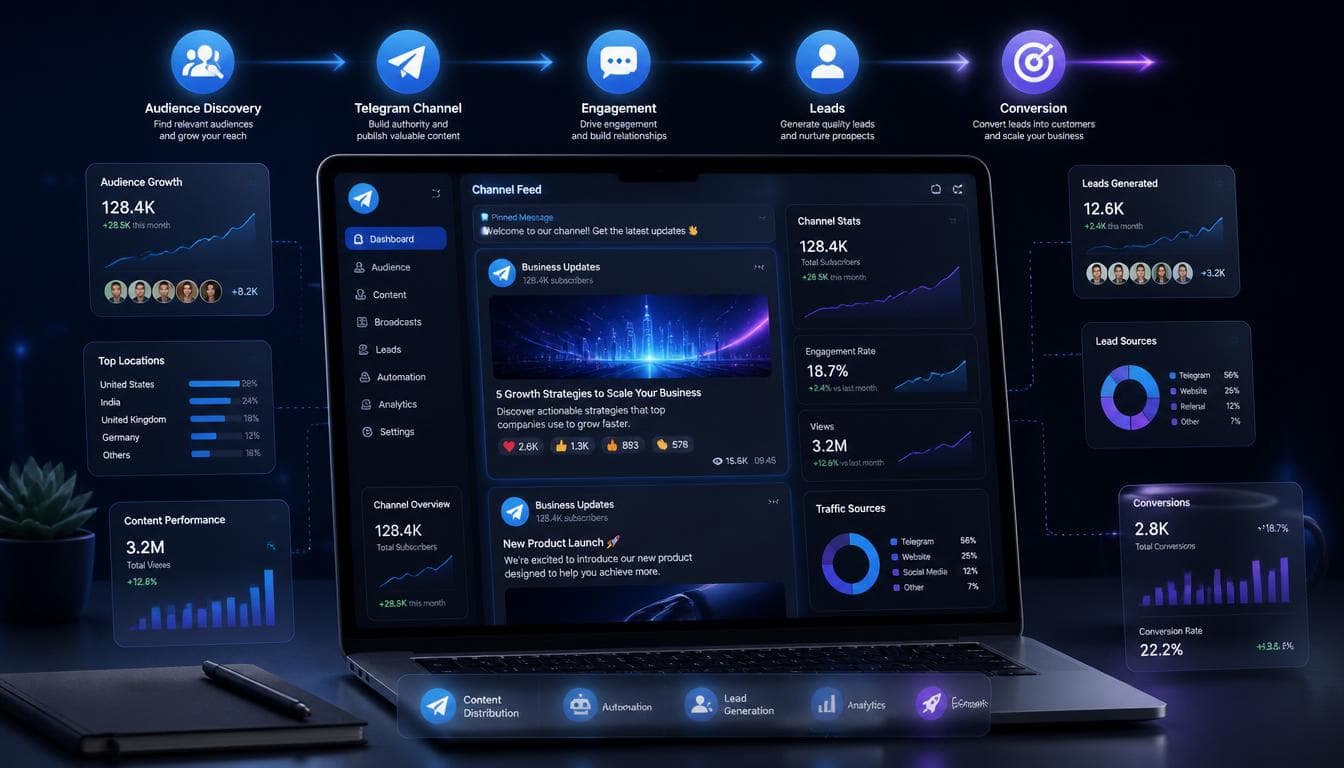
A useful marketing system looks more like this:
Discover
   ↓
Join
   ↓
Consume content
   ↓
Engage
   ↓
Trust
   ↓
Take action
   ↓
Return
The goal is to move people through this journey rather than focusing only on audience size.
Telegram advertising can also affect the user experience of public channels. If you’re wondering whether channel owners can control or remove sponsored messages, read our complete guide on how to disable Telegram ads in a channel.
Why Businesses Use Telegram for Marketing
Telegram can be useful for businesses that want a more direct relationship with their audience.
Unlike relying entirely on algorithm-driven social feeds, a Telegram channel can provide a dedicated place for publishing updates, offers, educational content, and announcements.
Common use cases include:
- Product announcements
- Content distribution
- Community building
- News and updates
- Promotions
- Educational content
- Customer communication
- Lead nurturing
- Exclusive content
- Customer retention
The best use case depends on the business model.
For example, an e-commerce brand may use Telegram for product launches and offers, while a SaaS company may use it for product updates, tutorials, and customer education.
Step 1: Define Your Telegram Marketing Goal
Before creating a content calendar or promoting your channel, decide what Telegram is supposed to achieve for your business.
Avoid vague goals such as:
“We want more Telegram members.”
Instead, define an outcome.
For example:
Brand Awareness
Goal:
Reach more people who match your target audience.
Possible metrics:
- Reach
- Views
- New subscribers
- Website traffic
Lead Generation
Goal:
Turn Telegram users into potential customers.
Possible metrics:
- Link clicks
- Form submissions
- Sign-ups
- Qualified leads
For businesses that want to turn a Telegram audience into a revenue source, it’s also important to understand the different ways a channel can generate income. See our guide on how to monetize a Telegram channel.
Sales
Goal:
Generate purchases or conversions.
Possible metrics:
- Conversion rate
- Sales
- Revenue
- Average order value
Customer Retention
Goal:
Keep existing customers informed and engaged.
Possible metrics:
- Repeat visits
- Returning customers
- Engagement
- Retention
Your content and promotion strategy should be based on the outcome you want.
Step 2: Understand Your Target Audience
A Telegram marketing strategy works best when you know who you are trying to reach.
Start by defining:
- Who are they?
- What problems do they have?
- Why would they join your channel?
- What type of content do they want?
- How often do they want updates?
- What action do you eventually want them to take?
You can create a simple audience profile.
| Question | Example |
|---|---|
| Audience | Small business owners |
| Main problem | Need affordable marketing channels |
| Content interest | Marketing tips and practical guides |
| Desired action | Visit website and sign up |
| Preferred format | Short tips, guides, case studies |
The more clearly you understand the audience, the easier it becomes to create relevant content.
Step 3: Choose the Right Telegram Format
Telegram offers different ways to communicate, and the right format depends on your strategy.
Telegram Channels
Channels are generally useful for:
- Broadcasting announcements
- Publishing content
- Sharing updates
- Promoting offers
- Building an audience
They work well when the business primarily wants to communicate outward to an audience.
Telegram Groups
Groups are more suitable when conversation and community participation are important.
They can be useful for:
- Customer communities
- Support
- Networking
- Feedback
- Discussions
Some businesses may use both:
Telegram Channel
      ↓
News + Content + Offers

Telegram Group
      ↓
Community + Discussion + Support
The key is to avoid creating a group simply because Telegram has one. Choose the format based on how you want users to interact.
Step 4: Build a Telegram Content Strategy
Content is the core of your Telegram marketing strategy.
If every post is a promotion, users may eventually ignore your messages or leave the channel.
A stronger approach is to create multiple content categories.
For example:
Educational Content
Teach your audience something useful.
Examples:
- How-to guides
- Tips
- Tutorials
- Industry insights
Product Content
Explain how your product or service solves a problem.
Examples:
- Feature announcements
- Use cases
- Product tutorials
- Updates
Social Proof
Use evidence that builds trust.
Examples:
- Customer stories
- Reviews
- Case studies
- Results
Promotional Content
Use promotions selectively.
Examples:
- Special offers
- Product launches
- Limited campaigns
Community Content
Encourage participation.
Examples:
- Questions
- Polls
- Discussions
- Feedback requests
A simple mix could look like:
40% Educational
25% Product / Business
20% Community / Engagement
15% Promotional
This is not a universal formula, but it can help prevent a channel from becoming a continuous stream of advertisements.
Step 5: Create a Consistent Publishing Schedule
Consistency helps your audience know what to expect.
However, posting more frequently is not always better.
The right publishing schedule depends on:
- Audience behavior
- Content type
- Industry
- Available resources
- Channel goals
Start with a schedule you can maintain.
For example:
| Day | Content |
|---|---|
| Monday | Educational tip |
| Tuesday | Industry update |
| Wednesday | Product or service content |
| Thursday | Poll or question |
| Friday | Case study or promotion |
After collecting data, adjust the schedule based on what your audience actually responds to.
Step 6: Promote Your Telegram Channel
A marketing strategy also needs a distribution plan.
Useful promotion methods may include:
- Your website
- Email newsletters
- Social media
- Existing communities
- Cross-promotion with relevant channels
- Partnerships
- Telegram advertising options
- Influencer collaborations
The goal is not simply to place your Telegram link everywhere.
Focus on places where your target audience is already active.
For example:
Website Visitor
      ↓
Relevant CTA
      ↓
Telegram Channel
      ↓
Useful Content
      ↓
Website / Product
      ↓
Conversion
Your website can become one of the most valuable sources of Telegram subscribers because visitors already have some level of interest in your business.
Step 7: Use Telegram for Lead Generation
Telegram can also be part of a lead-generation funnel.
Instead of sending every user directly to a sales page, provide a reason for them to stay connected.
For example:
Social Media / Search
        ↓
Free Resource
        ↓
Telegram Channel
        ↓
Educational Content
        ↓
Offer
        ↓
Landing Page
        ↓
Conversion
Possible lead-generation content includes:
- Guides
- Checklists
- Industry updates
- Templates
- Exclusive content
- Early access
- Special offers
The important part is to connect Telegram activity with a measurable business goal.
Step 8: Use Engagement to Understand Your Audience
Engagement is not only about getting more reactions.
It can also help you understand what your audience finds useful.
Pay attention to:
- Post views
- Reactions
- Poll responses
- Replies
- Link clicks
- Questions
- Content topics that perform well
For example, if educational posts consistently receive more views and interaction than promotional posts, that may indicate your audience values educational content.
Use that information to improve your future content.
Step 9: Use Automation Carefully
Automation can help businesses manage repetitive tasks.
Depending on your setup, automation may be useful for:
- Welcome flows
- Content delivery
- Customer support
- Notifications
- Lead qualification
- FAQ responses
However, automation should support the customer experience rather than make communication feel completely impersonal.
Start with simple processes and improve them over time.
Businesses can also use dedicated tools to manage different Telegram-related activities from one place. The Membersgram Web App brings together available Telegram services and account features in a centralized dashboard.
Step 10: Measure Your Telegram Marketing Results
Without measurement, it is difficult to know whether your strategy is working.
Track metrics that connect to your original goal.
Awareness
- Reach
- Views
- Subscriber growth
Engagement
- Reactions
- Poll participation
- Replies
- Link interactions
Traffic
- Website visits
- Click-through rate
Leads
- Sign-ups
- Form submissions
- Qualified contacts
Sales
- Conversions
- Revenue
- Customer acquisition
A simple reporting table can help:
| Goal | Metric | Result |
|---|---|---|
| Awareness | Post views | Track monthly |
| Engagement | Reactions and responses | Compare content |
| Traffic | Link clicks | Use tagged links |
| Leads | Sign-ups | Track conversions |
| Sales | Revenue | Connect to campaigns |
Avoid measuring success using only member count.
A smaller but relevant audience may create better business results than a large audience with little interest in your product.
Common Telegram Marketing Mistakes
Focusing Only on Subscriber Numbers
A large audience is not automatically valuable.
Focus on relevance, engagement, and business outcomes.
Posting Only Promotional Content
Users usually need a reason to continue following a business channel.
Provide useful information in addition to promotions.
Publishing Without a Clear Goal
Every major campaign should have an objective.
Otherwise, it becomes difficult to measure success.
Ignoring Audience Feedback
Polls, questions, comments, and engagement patterns can provide useful insights.
Using the Same Strategy Forever
Audience behavior changes.
Review your content and performance regularly.
Telegram Marketing Strategy Checklist
Before launching or improving your Telegram marketing efforts, check:
- Define your business goal
- Identify your target audience
- Choose a channel, group, or combination
- Create clear content categories
- Build a realistic publishing schedule
- Create a promotion plan
- Connect Telegram to your website or landing pages
- Track important metrics
- Review performance regularly
- Improve based on audience behavior
Frequently Asked Questions
What is Telegram marketing?
Telegram marketing is the use of Telegram channels, groups, advertising options, bots, and other available features to achieve marketing goals such as audience building, lead generation, content distribution, customer communication, or sales.
Member acquisition can be one part of a strategy, but a business also needs to consider what happens after someone joins.
If your main goal is learning how to build and grow a Telegram audience, read our complete guide on how to grow a Telegram channel.
Is Telegram good for business marketing?
It can be useful for businesses that have a clear reason for their audience to join and stay engaged. The effectiveness depends on the audience, content, offer, and overall marketing strategy.
How can businesses promote a Telegram channel?
Businesses can promote a Telegram channel through their website, email lists, social media, partnerships, cross-promotion, relevant communities, advertising options, and other distribution channels where their target audience is active.
How often should a business post on Telegram?
There is no single ideal frequency. Choose a schedule that matches your audience and that you can maintain consistently without sacrificing content quality.
What should businesses measure on Telegram?
Metrics may include views, engagement, link clicks, traffic, leads, conversions, revenue, and retention, depending on the business objective.
Final Thoughts
A successful Telegram marketing strategy is not about posting more content or simply collecting more subscribers.
It starts with a clear business objective and connects audience acquisition, content, engagement, distribution, and conversion into one system.
The most effective approach is to understand why people should join your Telegram channel, give them a reason to stay, and create a clear path from Telegram activity to a meaningful business outcome.
Telegram can become a valuable marketing channel when it is integrated into your wider business and marketing strategy rather than treated as an isolated platform
Grow your telegram channel
Get Members, Views, Reacts, boost and more.